

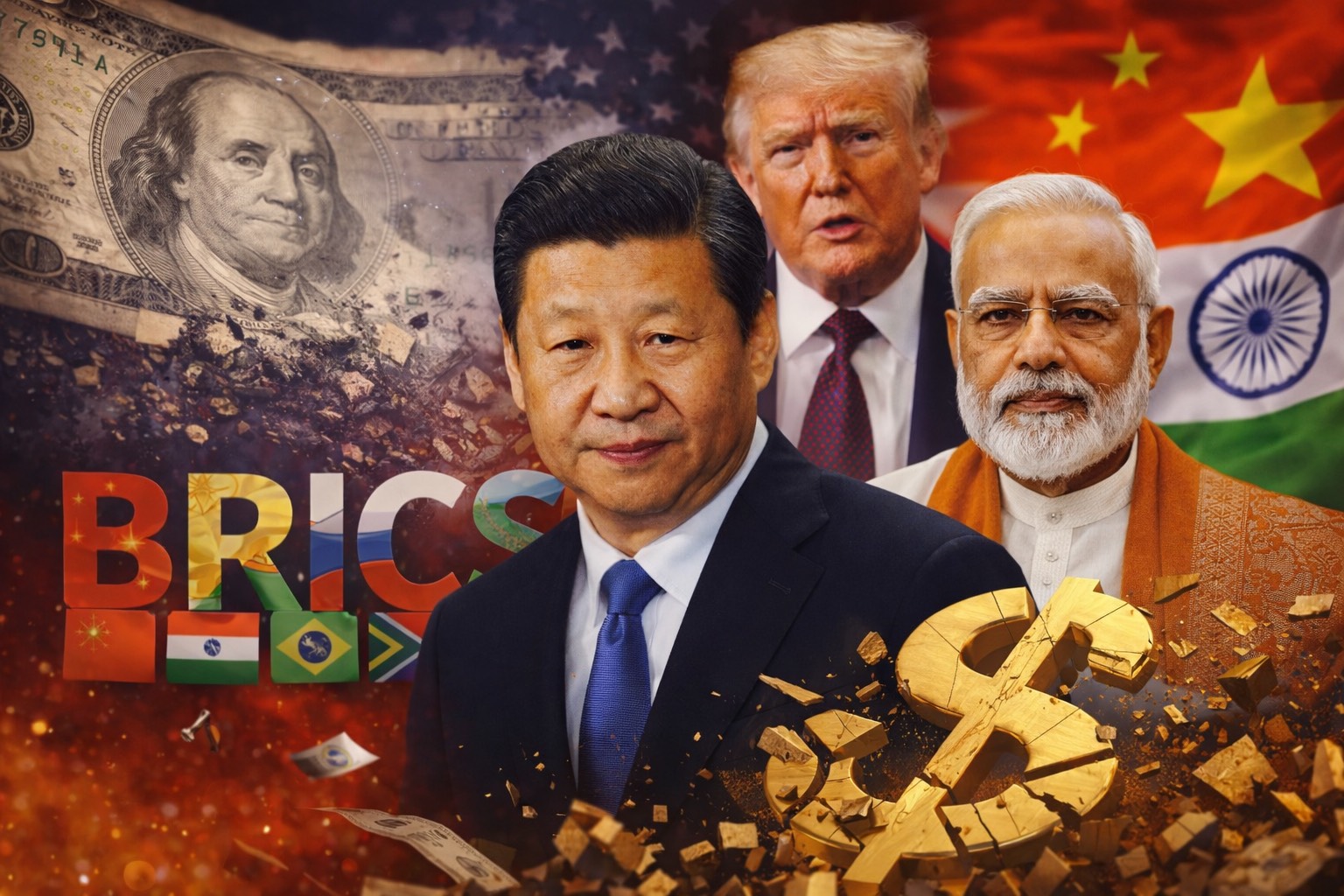
ISLAMABAD: A growing group of emerging economies led by China and BRICS nations is reducing reliance on the US dollar, signaling a gradual realignment of the global financial system amid rising geopolitical and economic pressures.
For decades, the dollar has dominated international trade, foreign reserves and commodity markets. But countries across Asia, Africa, Latin America and the Middle East are increasingly questioning the risks of depending on a single currency controlled by one government.
China, India and Russia are among the key drivers of this shift.
Over the past year, India has sold more than $50 billion in US Treasury holdings, cutting its reserves by around 21 percent. This marks the steepest annual decline in four years.
China also reduced its exposure, selling roughly $71 billion in US government debt between October 2024 and October 2025, according to market data.
Collectively, BRICS members trimmed nearly $29 billion from their US Treasury portfolios within a single month, reflecting what analysts describe as a coordinated adjustment in reserve management.
The trend comes as US government debt surpasses $38 trillion, while volatility in interest rates and falling bond prices have pushed borrowing costs higher.
Geopolitical risks are adding momentum. Western sanctions that froze Russian dollar assets highlighted how reserve currencies can be weaponized, prompting many countries to diversify away from dollar-denominated holdings.
Gold has re-emerged as a preferred reserve asset due to its insulation from sanctions and default risk. Several central banks have increased gold purchases as part of broader diversification strategies.
Trade settlement is also shifting. China now conducts transactions in yuan with more than 40 countries, while India has opened special rupee accounts with banks in over 20 nations to facilitate cross-border payments.
BRICS members are exploring alternative payment systems, including digital currency platforms backed by national currencies and gold, aimed at reducing dependence on traditional dollar-based channels.
Financial analysts say the dollar is unlikely to lose its role as a major global currency, but its era of unchallenged dominance is fading as multipolar financial structures take shape.